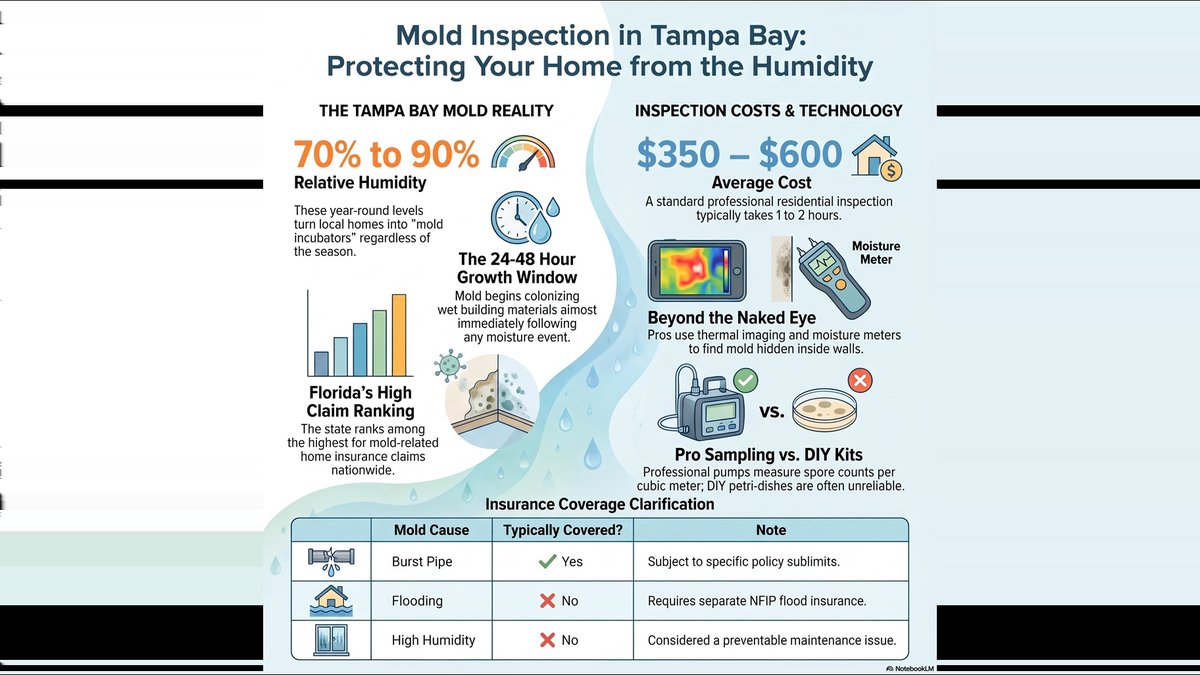
Tampa Bay ranks among America's moldiest cities. Tropical storms and year-round humidity levels between 70% and 90% create conditions favorable for mold growth in residential properties. According to federal research from the National Institute for Occupational Safety and Health (NIOSH), nearly 47% of U.S. homes have visible mold or a detectable mold odor; industry studies suggest that when hidden growth and favorable conditions are included, the percentage may be higher. In response to widespread homeowner confusion about inspection processes, costs, and insurance coverage, TampaBayMold.net has released a guide addressing the 11 most frequently asked questions about mold inspections across Hillsborough, Pinellas, Pasco, Manatee, and Sarasota counties.
More information is available at https://tampabaymold.net/services/mold-inspection/
The newly published resource draws on 17 years of mold experience and 14 years serving Tampa Bay, one of Florida's most mold-prone regions. Homeowners receive detailed answers to questions ranging from inspection costs to insurance coverage limitations. Many residents assume standard home inspections cover mold detection; the guide clarifies that general inspectors lack the specialized tools and training required to identify hidden mold behind walls, beneath flooring, or inside HVAC systems where spores can circulate throughout entire homes.
Financial stakes drive much of the urgency behind the guide's release. Professional mold inspections in the Tampa Bay area typically cost between $350 and $600 for standard residential properties; remediation expenses can reach $11,400 or more when problems go undetected until after purchase or when moisture issues remain unaddressed for extended periods. The guide cites an internal case study in which a Seminole buyer's standard home inspection passed without issue. A post-purchase mold inspection three months later revealed Chaetomium and Penicillium growth requiring four-figure remediation, a problem that elevated moisture readings would have flagged during pre-purchase evaluation. Insurance coverage adds another layer of complexity; most Florida homeowners policies cap mold coverage at $10,000 to $25,000 and exclude damage resulting from long-term humidity or maintenance issues rather than sudden, accidental water events.
Professional inspectors use thermal imaging cameras to detect temperature differentials indicating moisture intrusion inside wall cavities. Moisture meters measure water content in building materials, and borescopes examine spaces without demolition. These tools enable detection of hidden mold that develops within 24 to 48 hours of water exposure, growth that visual inspection alone cannot identify. The guide emphasizes that bathrooms, attics, crawl spaces, and HVAC air handlers represent the highest-risk areas in Tampa Bay homes, where condensation from overworked air conditioning systems and poor ventilation create persistent moisture problems even without flooding or pipe bursts.
A critical distinction the guide addresses involves the difference between mold inspection and mold testing. Homeowners often use these terms interchangeably despite representing separate processes with different costs and purposes. Inspection involves physical evaluation using visual assessment and specialized equipment to identify growth and moisture sources, while testing requires laboratory analysis of air or surface samples to identify specific species and spore concentrations. Florida regulatory framework under Statutes 468.841-468.843 mandates that mold assessment and remediation must be performed by different licensed professionals to prevent conflicts of interest, a consumer protection measure that affects how homeowners should approach the inspection and remediation process.
The guide strongly recommends pre-purchase mold inspection for all Tampa Bay home buyers. Standard home inspections evaluate general property conditions but lack the focused moisture evaluation and specialized equipment necessary to detect hidden contamination. Beyond pre-purchase scenarios, TampaBayMold.net recommends routine inspections every one to two years given the region's subtropical climate, with additional inspections following tropical storms, roof leaks, plumbing failures, or any water intrusion event. Proper documentation from professional inspections also supports insurance claims when mold results from covered perils, though homeowners should review policy language carefully as coverage has tightened significantly across Florida insurers over the past decade.
For more details, visit https://www.tampabaymold.net